Scripture Passages
- John 2:18-22 (ESV)
18 So the Jews said to him, “What sign do you show us for doing these things?”
19 Jesus answered them, “Destroy this temple, and in three days I will raise it up.”
20 The Jews then said, “It has taken forty-six years to build this temple, and will you raise it up in three days?”
21 But he was speaking about the temple of his body.
22 When therefore he was raised from the dead, his disciples remembered that he had said this, and they believed the Scripture and the word that Jesus had spoken. - Luke 24:36-43 (ESV)
36 As they were talking about these things, Jesus himself stood among them, and said to them, “Peace to you!”
37 But they were startled and frightened and thought they saw a spirit.
38 And he said to them, “Why are you troubled, and why do doubts arise in your hearts?
39 See my hands and my feet, that it is I myself. Touch me, and see. For a spirit does not have flesh and bones as you see that I have.”
40 And when he had said this, he showed them his hands and his feet.
41 And while they still disbelieved for joy and were marveling, he said to them, “Have you anything here to eat?”
42 They gave him a piece of broiled fish,
43 and he took it and ate before them. - John 20:26-28 (ESV)
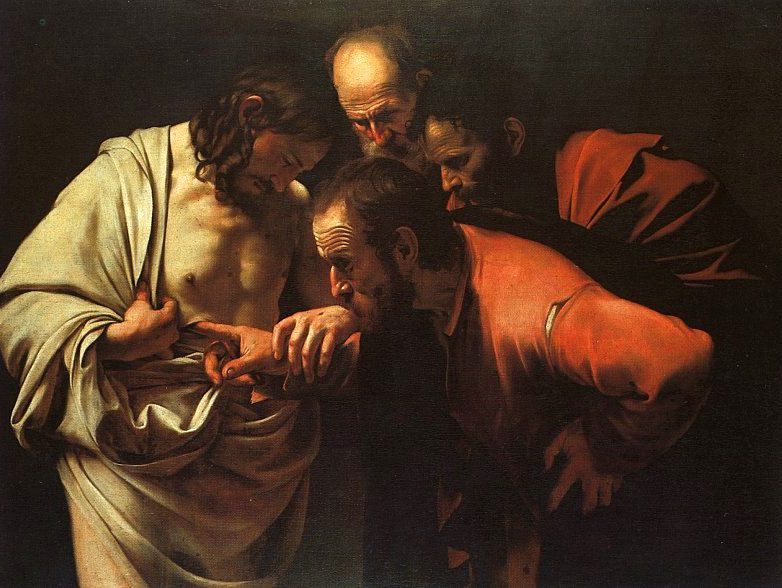
26 Eight days later, his disciples were inside again, and Thomas was with them. Although the doors were locked, Jesus came and stood among them and said, “Peace be with you.”
27 Then he said to Thomas, “Put your finger here, and see my hands; and put out your hand, and place it in my side. Do not disbelieve, but believe.”
28 Thomas answered him, “My Lord and my God!” - Acts 2:32 (ESV)
32 This Jesus God raised up, and of that we all are witnesses.
Other Evidence for Christ’s Resurrection
- The conversion of James – James was a doubter, yet after the resurrection of Jesus, he became a central figure in the church and bishop of the church at Jerusalem. What caused his change?
- The conversion of Paul – Paul was a Pharisee and hunted and killed Christians. Then there was a change, a 180 degree turnabout, and Paul spent the rest of his life traveling the Mediterranean telling people about Jesus’ resurrection. What caused him to change?
- The existence of the church – History records the existence of the church near the time of the death of Jesus, in the city where He died, preaching His resurrection where His tomb lay.
- The violent deaths of most of Jesus’ apostles. Men might die for their faith, but not for something they know isn’t true:
- Thomas was run through with a spear
- Peter was crucified upside down after first watching the crucifixion of his wife.
- Bartholomew was skinned alive.
- Andrew was crucified
- James was executed by Herod (Acts 12).
- Philip, like Peter, is said to have been crucified upside down
- Matthew was martyred, but his death is not described.
- James the son of Alphaeus was stoned to death by an angry mob.
- Thaddaeus Also called St. Jude, along with Simon the Zealot, were run through with spears by an angry mob. Andrew is said to have looked at the crowd then turned to Simon and said, “I see that the Lord is calling us.” Simon was then sawn to pieces.
- Judas Iscariot, of course, hanged himself
- Matthias was elected to be the replacement for Judas Iscariot (Acts 1:15-26) and was stoned to death in Jerusalem by an angry mob of Jews around 51 a.d.
- Paul was beheaded in Rome during Nero’s reign.
- James the Just was the half-brother of Jesus and head of the church in Jerusalem. James was taken to the top of the wall of the temple and thrown down. The fall did not kill him, though. He was stoned and beaten to death.
Extrabiblical Evidence for Jesus’ Resurrection
Tacitus
The Roman historian Tacitus, writing in about 115 A.D., records the events surrounding Emperor Nero in July of A.D. 64. After the fire that destroyed much of Rome, Nero was blamed for being responsible:
Consequently, to get rid of the report, Nero fastened the guilt and inflicted the most exquisite tortures on a class hated for their abominations, called Christians by the populace. Christus [Christ], from whom the name had its origin, suffered the extreme penalty during the reign of Tiberius at the hands of one of our procurators, Pontius Pilate, and a most mischievous superstition [Christ’s resurrection] thus checked for the moment, again broke out not only in Judea, the first source of the evil, but even in Rome, where all things hideous and shameful from every part of the world find their center and become popular.
Josephus
Josephus, a Jewish historian writing (to please the Romans) at the end of the first century A.D. says this in his Antiquities (18,3,3):
About this time there lived Jesus, a wise man, if indeed one ought to call him a man. For he was one who performed surprising deeds and was a teacher of such people as accept the truth gladly. He won over many Jews and many of the Greeks. He was the Messiah. And when, upon the accusation of the principal men among us, Pilate had condemned him to a cross, those who had first come to love him did not cease. He appeared to them spending a third day restored to life, for the prophets of God had foretold these things and a thousand other marvels about him. And the tribe of the Christians, so called after him, has still to this day not disappeared. (Based on the translation of Louis H. Feldman, The Loeb Classical Library.) (http://www.josephus.org/testimonium.htm)
Church Fathers
Ignatius (A.D. 35-110)
“He was crucified and died under Pontius Pilate. He really and, not merely in appearance, was crucified, and died, in sight of beings in heaven, and on earth, and under the earth.
“He also rose again in three days.”
 AnswersAZ